


Marine Battery for Boat: BMS, CAN, J1939 and NMEA 2000 Guide
2026-09-21
Introduction
As electric propulsion, hybrid vessels and intelligent marine electronics continue to develop, a marine battery is becoming much more than a standalone source of electrical power.
A modern marine battery for boat applications may need to support propulsion loads, onboard electrical equipment and communication with chargers, displays, motor controllers or other vessel equipment.
This means that choosing a marine lithium battery should involve more than voltage and Ah capacity. BMS protection, discharge capability, communication compatibility and the complete vessel architecture should also be considered.
This guide explains how a marine battery BMS works, why CAN Bus is used, where the J1939 protocol and NMEA 2000 network fit into marine systems, and what buyers should confirm before ordering a custom electric boat battery.
For a basic introduction to battery data exchange, read our What Is Lithium Battery Communication?.
What Is a Marine Battery for a Boat?
A marine battery for boat applications is a battery system selected or designed according to the vessel's electrical requirements, loads, installation environment and operating conditions.
Depending on the vessel, the battery may supply power for:
- Electric propulsion
- Onboard electrical loads
- Navigation and communication equipment
- Lighting and marine electronics
- Auxiliary systems
- Backup power
For an electric boat battery, the battery may directly supply a propulsion motor system. In this case, capacity alone is not enough.
The project must also consider continuous discharge current, peak current, BMS protection and compatibility with the propulsion system.
For yachts and recreational vessels, the marine lithium battery system may also need to work with chargers, inverters, MFDs and onboard monitoring equipment.
There is no single battery specification that is ideal for every boat. The battery must be matched to the vessel and its actual operating requirements.
How Does a Marine Battery BMS Work?
The Battery Management System is one of the most important parts of a modern marine lithium battery.
The marine battery BMS monitors battery operating conditions and performs protection, calculation and communication functions according to the system design.
Typical information may include:
-
Cell voltage
-
Pack voltage
-
Charge and discharge current
-
Temperature
-
SOC
-
SOH
-
Battery status
-
Fault information
If a cell voltage becomes abnormal, battery temperature exceeds the configured range or current rises beyond the designed limit, the BMS can respond according to its protection strategy.
In a connected boat battery system, the BMS may also provide battery information to compatible external equipment.
A simple architecture is:
Battery Cells → BMS → Communication Interface → Target Equipment
The BMS is therefore not only responsible for battery protection. It can also act as an important data interface between the battery pack and the vessel system.
Why Does a Marine Battery Need CAN Bus?
CAN Bus provides a reliable communication foundation for electronic devices in vehicles, industrial machinery and marine power systems.
In an electric boat battery system, a typical architecture may be:
Marine Battery → BMS → CAN → Propulsion Controller
Depending on the protocol and project configuration, equipment may exchange information such as:
SOC → Voltage → Current → Temperature → Battery Status → Fault Information
However, one point is especially important:
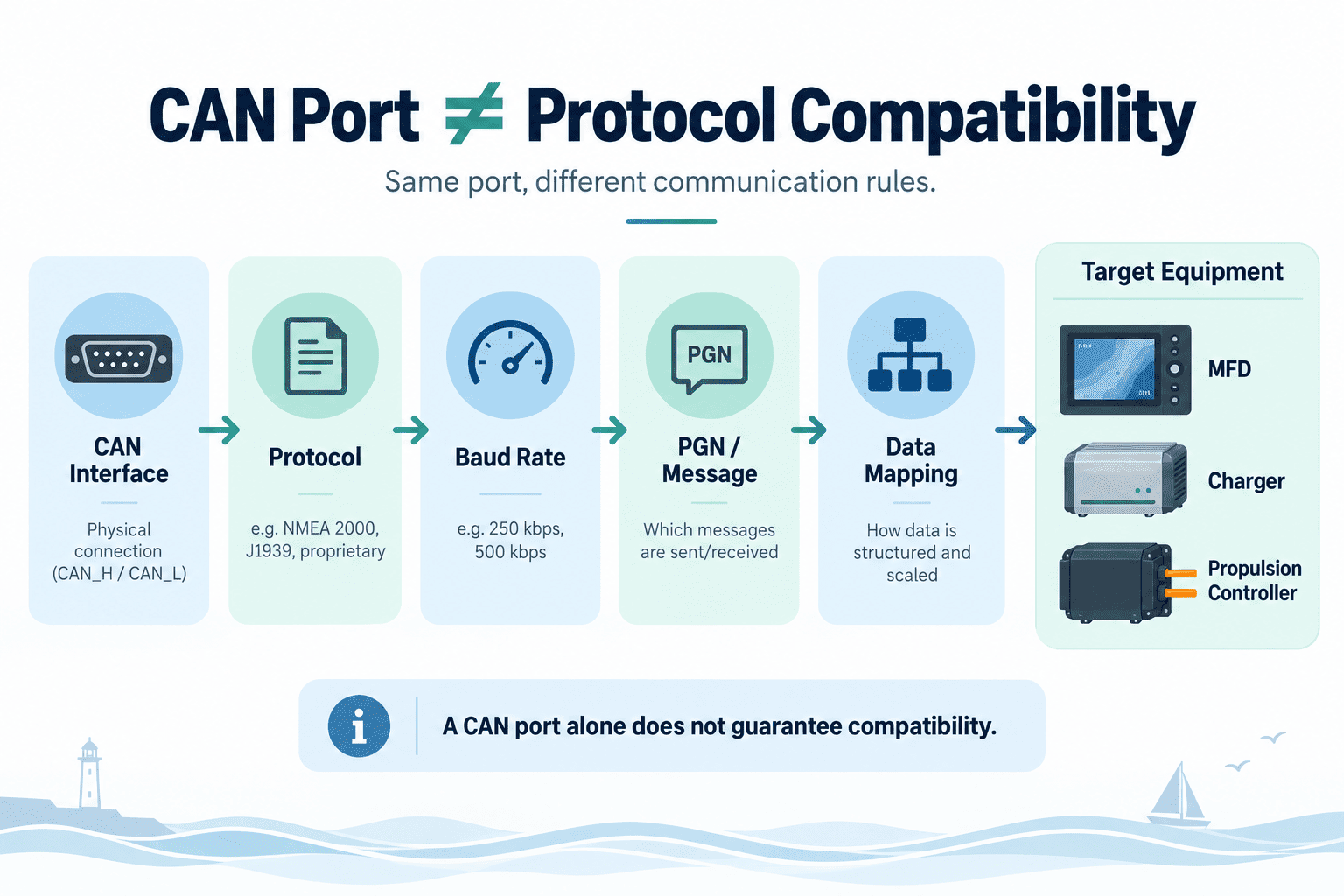
A CAN port alone does not guarantee communication compatibility.
CAN provides the communication foundation, while the higher-level protocol defines how information is structured and interpreted.
Therefore:
CAN Port ≠ J1939 Compatibility
CAN Port ≠ NMEA 2000 Compatibility
For a custom marine battery project, saying “I need CAN” is usually not enough.
The battery manufacturer also needs to understand the protocol and the target equipment.
What Is the J1939 Protocol?
SAE J1939 is a family of communication standards built on CAN technology.
It defines how devices organize and exchange information, including the use of Parameter Group Numbers, or PGNs.
Although J1939 is strongly associated with heavy-duty vehicles and industrial equipment, SAE also publishes guidance applying J1939 to marine engine systems, confirming its use in marine applications.
A possible electric propulsion architecture is:
Electric Boat Battery → BMS → J1939 CAN → Propulsion Controller
Depending on the project, battery information may include:
- SOC
- Voltage
- Current
- Temperature
- Battery status
- Fault information
- Charge and discharge limits
The correct J1939 implementation should be determined by the requirements of the connected controller.
The protocol should be matched to the target equipment rather than selected independently by the battery manufacturer.
For a detailed explanation, continue with our upcoming What Is SAE J1939? guide.
What Is an NMEA 2000 Network?
NMEA 2000 is a marine electronics networking standard developed by the National Marine Electronics Association.
According to NMEA, the standard is based on CAN communication and provides a bidirectional, multi-transmitter and multi-receiver network for interconnecting compatible marine electronic equipment.
Instead of requiring every device to have an individual point-to-point connection, compatible equipment can share information through the vessel network.
For a marine battery system, one possible architecture is:
Marine Lithium Battery → BMS → NMEA 2000 Network → MFD
Compatible displays may then use supported battery information for onboard monitoring.
Victron, for example, documents an NMEA 2000 integration architecture in which battery-monitor and inverter/charger data can be made available to compatible marine MFDs.
NMEA's current PGN suite also includes Battery Management and Electric Propulsion categories, and the organization has added dedicated PGNs to support the expanding electric propulsion and battery-management market.
NMEA 2000 is therefore relevant not only to navigation data, but also to modern vessel monitoring and electrification.
For projects requiring NMEA 2000 integration, compatibility and applicable certification requirements should be confirmed during the project stage. NMEA states that products that read or transmit NMEA 2000 information must be
J1939 vs NMEA 2000: What Is the Difference?
J1939 and NMEA 2000 are both CAN-based technologies, but they are not interchangeable protocols.
In practical marine applications:
NMEA 2000 is strongly associated with vessel electronics networking, monitoring and multi-device data integration.
J1939 is commonly encountered in engine, propulsion and power-control communication.
NMEA itself notes that NMEA 2000 is one form of CAN-based networking and that other CAN networks, including J1939, also have a place in the marine network environment.
For a marine battery for boat project, the better question is therefore not:
“Which protocol is better?”
It is:“Which equipment does the battery need to communicate with?”
For example:
Marine Battery → NMEA 2000 → MFD
may be focused on vessel monitoring and network integration.
While: Marine Battery → J1939 → Propulsion Controller may be focused on propulsion-system data exchange.
How to Match a Marine Battery with Boat Equipment
Communication matching should start with the target equipment rather than with the battery interface.
A better process is:
Target Equipment → Communication Requirement → Required Battery Data → BMS Configuration → Integration Testing
For example:
Electric Boat → 96V 100Ah Battery → Propulsion Controller → J1939 → SOC / Voltage / Current
or:
Yacht → Marine Lithium Battery → NMEA 2000 → MFD → Battery Monitoring
For an OEM or ODM marine battery project, useful information includes:
- Vessel type
- Battery voltage
- Required capacity
- Continuous current
- Peak current
- Target equipment
- Brand and model
- Communication protocol
- Required battery data
- Communication documentation
- Installation dimensions
The earlier these requirements are confirmed, the easier it is to evaluate BMS and system compatibility before production.
How to Choose a Marine Battery for Your Boat
Communication is only one part of selecting a marine battery for boat applications.
Voltage and Capacity
Battery voltage must match the vessel's electrical or propulsion system.
Capacity should be selected according to required runtime and energy consumption.
Continuous and Peak Discharge Current
For an electric boat battery, Ah capacity alone does not determine whether the battery can operate the propulsion system.
Continuous and peak discharge current must also match motor and controller requirements.
BMS Protection
A marine battery BMS may include protection functions such as:
- Overcharge protection
- Over-discharge protection
- Over-current protection
- Short-circuit protection
Marine Operating Environment
Boat batteries may operate under conditions involving:
vibration, humidity, salt exposure, splashing, vessel movement and temperature changes.
Battery enclosure design, terminals, connectors, mounting and ingress protection therefore need to be evaluated according to the actual installation.
Communication Compatibility
If the battery must work with an MFD, charger, inverter, motor controller or propulsion controller, communication requirements should be confirmed before battery production.
Do not wait until the battery is finished before checking whether the target equipment can communicate with it.
Custom Marine Lithium Battery Solutions
Standard batteries cannot always satisfy different vessel layouts, propulsion systems and communication requirements.
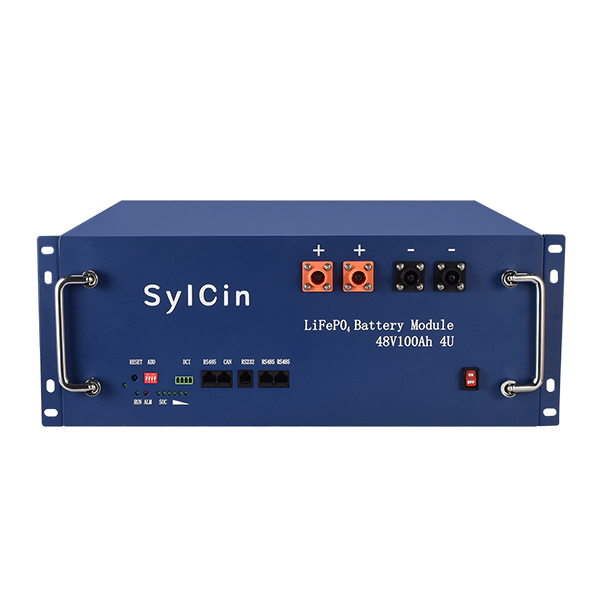
For OEM and ODM projects, SylCin can evaluate requirements including:
Voltage + Capacity + Discharge Requirement + BMS + CAN Communication + Enclosure + Connector + Parallel Configuration
For example, a 96V electric boat battery project may require the battery capacity, continuous discharge capability, propulsion controller and communication requirements to be considered together.
Communication should be treated as part of the complete marine battery design rather than as an isolated feature.
Learn more about our Marine Battery Solutions.
For projects requiring customized voltage, capacity, BMS, enclosure or communication configuration, explore our Custom Lithium Battery Solutions.
Marine Battery for Boat FAQ
1. What is the difference between a marine battery and a car battery?
A marine battery needs to be selected according to vessel loads, environmental conditions and operating requirements. Electric propulsion applications also require appropriate discharge capability and BMS protection.
2. Can a marine lithium battery power an electric boat?
Yes, when the battery voltage, capacity, continuous current, peak current and BMS are correctly matched to the propulsion system.
3. What does a marine battery BMS do?
The BMS monitors battery operating conditions, provides protection and may exchange battery information with compatible external equipment.
4. Is CAN Bus the same as J1939?
No.
CAN provides the communication foundation. J1939 defines higher-level communication rules used on CAN networks.
5. What is an NMEA 2000 network?
NMEA 2000 is a CAN-based marine networking standard that enables compatible vessel electronics to share information through a common network.
You can read our follow-up article,"What Is NMEA 2000?"
6. Can a marine battery connect directly to an MFD?
Possibly, but compatibility depends on the battery BMS, target MFD, supported protocol and data definitions.
A CAN connector alone does not guarantee compatibility.
7. Is J1939 used on boats?
Yes, J1939 has documented marine applications, including SAE guidance for certain marine engine systems.
8. What information is required for a custom marine battery project?
Provide the vessel type, voltage, capacity, motor power, continuous and peak current requirements, target equipment, installation space and communication requirements.
If CAN communication is required, communication documentation from the target equipment is especially useful.
Conclusion
Choosing a marine battery for boat applications involves much more than comparing voltage, Ah capacity and price.
For modern electric boats, yachts and connected vessel systems, the complete process should be considered as:
Vessel Requirements → Battery Specification → BMS → Communication → Target Equipment
The BMS protects and monitors the battery. CAN provides a communication foundation, while protocols such as J1939 and NMEA 2000 determine how compatible devices exchange and interpret information.
For projects involving an MFD, propulsion controller, charger or other connected marine equipment, communication requirements should be confirmed early in the battery design process.
Explore SylCin's Marine Battery Solutions or Custom Lithium Battery Solutions for OEM and ODM projects.
Developing an electric boat or custom marine battery system? Send us your battery specifications, motor or controller model and communication requirements. Contact SylCin for project evaluation.
What Kind of Battery Does a Forklift Use ? A Complete Guide to Forklift Batteries in 2026
Related Article

Discover what kind of battery a forklift uses and compare lead-acid vs lithium forklift batteries. Learn about forklift battery capacity, lifespan, charging, maintenance, and how to choose the best electric forklift battery for your business in 2026.
What Kind of Battery Does a Forklift Use ? A Complete Guide to Forklift Batteries in 2026
Best Selling Product








Would you like to talk to us about your battery project?

+0086 075527616594

sylcin02@sylcin.com

Room 1701, Building A, Zhongan Science and Technology Park, Dalang Street, Longhua District, Shenzhen